Lakeland Root Removal from Sewer Lines Under Mature Canopy
Part of what makes the historic districts worth living in is the canopy. The city’s own district narratives name live oak as the symbol of Beacon Hill and describe mature canopy in Dixieland, the Lake Morton districts, Biltmore-Cumberland and Lake Hunter Terrace. Under shade like that, a pipe laid in the 1920s or 1940s has had a long time to develop a gap.
Roots enter loose joints and cracks, grow toward the moisture inside, and fan out into a mat that catches paper and grease. The first sign is usually a toilet that slows. Then a main clears with a cable, fills again, and the pattern repeats.

Signs Roots Are Growing Into the Lateral
Roots tend to leave a recognizable pattern:
- A cable that comes back with brown, stringy fibers on it
- Slow drains that return every few months after each clearing
- Toilets and tubs gurgling when another fixture empties
- A mature tree or large shrub close to the line’s path from house to street
- A house from before the mid-1970s, when clay, cast iron and Orangeburg were in use
- Camera footage showing hair-fine roots at a joint
Root-Cutting Nozzles Versus Chemicals: What Clears the Pipe
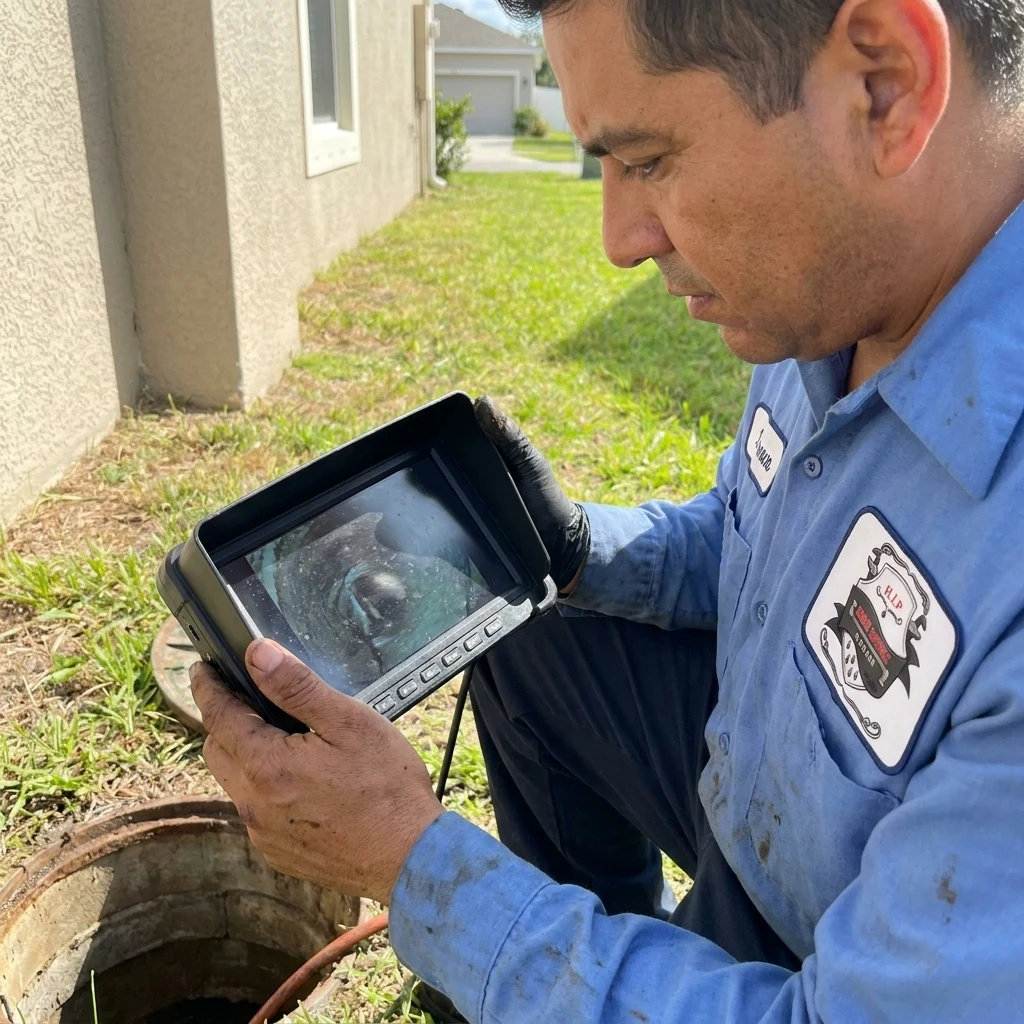
A jetter’s nozzle is matched to the job: one head for soft debris, another for roots. A root-cutting head works through the mass while the water flushes the pieces out of the pipe. Our work here is mechanical, and a camera pass before or after shows how much root remains and where it got in.
Chemical treatments are sold as the cheap alternative. A foaming or crystal root killer can kill growth it reaches, but it does not pull the mat out, and dead roots still block a pipe until something clears them. The opening stays open either way. If you have used one and the line still backs up, that is useful to tell the technician.
Roots come back. Clearing removes what is in the pipe, not the joint they came through, so regrowth is a question of how soon, which depends on the joint and the tree. The post on live-oak roots in older Lakeland neighborhoods explains what to expect. Roots can also hide fractures, which is why we look before applying pressure.
Root Removal Cost in Lakeland, and When Clearing Is Not Enough
Main line hydro jetting with moderate roots runs $400–$750. A plain main line snake run is $225–$450 and sometimes opens a line for the short term. A camera pass is $150–$300, often credited if you go ahead the same visit. Line length, access and how much root is in the pipe place a job within those ranges, and the cost guide has the detail.
Clearing is not enough when the footage shows a separated joint, an offset section or a pipe collapsed under the root mass. Roots in that case are a symptom, and the repair belongs to a plumber or repair contractor. We say so and show you the video; we do not sell a yearly clearing to a pipe that needs to be fixed.
Where We Run Root Removal in Lakeland and Polk County
In these districts the oldest trees and the oldest pipe share the same lots.
- Beacon Hill and Alta Vista — Live oak is the neighborhood symbol and the district is known for its expansive canopy, with mostly 1920s frame houses on larger lots along curving streets.
- Dixieland — Narrow lots with close setbacks, alleys and brick streets under mature canopy, built mostly between 1905 and 1940. Trees and lines sit close together.
- Biltmore-Cumberland — Mature canopy over narrow lots with few sidewalks, and 1940s and 1950s block houses. Any original clay or cast iron lateral there is exposed to root entry at its joints.
- Lake Hunter Terrace — Brick streets and mature canopy over houses built mostly around WWII, with vacant platted lots still in place. Original lines of that age are root-entry candidates.
- Cleveland Heights — The city calls the terrain scenic and rolling with mature trees, and lots were sold from 1925 on. Mixed pipe ages mean root intrusion shows up lot by lot.
- Bartow — Nicknamed the City of Oaks and Azaleas, with 1900s to 1920s housing in its county-seat core. Old pipe under old oaks is the root-removal pairing.
- Lake Morton (East and South) — Rolling lots under mature canopy, houses from 1920 to 1926 and some lots 200 feet deep. A long lateral under trees gives roots more joints to find.
Highways and Landmarks Around Our Lakeland Root Removal Work
- Lake Hollingsworth Drive — Circles the lake beside Florida Southern College, with big shade trees along its Cleveland Heights and Lake Morton blocks.
- Edgewood Drive and Buckingham Avenue — Cleveland Heights streets, where the city describes mature trees and rolling terrain; the golf course sits at 2900 Buckingham Ave.
- Cherokee and Seminole Trails — Two of Beacon Hill's six curving trails, laid out in the 1920s boom among large lots and live oaks.
- Francis Boulevard — A Biltmore-Cumberland street with a landscaped divider, running through a district of block houses under mature canopy.
- Sikes Boulevard — Skirts Lake Hunter Terrace, a district of brick streets, mature canopy and houses built mostly around WWII.
- Interstate 4 — Links Lakeland with Plant City, Polk City and Auburndale, which are all within an easy drive for a scheduled root visit.
- US 98 (Bartow Road) — Runs south-east to Bartow, nicknamed the City of Oaks and Azaleas, and its county-seat core.
Root and Canopy Numbers Behind Lakeland Root Removal
The canopy figure is a published study of Florida cities; the others come from a 2001 review of root intrusion in sewers.
- A 2001 review in the Journal of Infrastructure Systems, co-written by a USDA Forest Service scientist, notes that roots are reported to cause more than 50 percent of all sewer blockages. If a lateral under a mature canopy stops repeatedly, roots are the first suspect before grease or wipes, which is why the camera is part of the visit.
- The same review says root removal may cost about one-sixth as much as replacing a pipe because of roots. Cutting roots out of the line is the cheaper side of that comparison, although it does not seal the joint or crack the roots entered through.
- The review also notes that in smaller-diameter pipes, root removal every year or every other year is common. Home laterals are small-diameter pipes, so a line cut clear once can reasonably need clearing again within a year or two, and we say so up front.
- Lakeland's urban tree canopy covers 32.2 percent of the city, and 36.2 percent of its inhabited census blocks, based on 2019 aerial imagery. Roughly a third of the populated parts of the city sit under tree cover, which is the overlap that puts roots near underground sewer laterals.
- Clay sewer pipe was typically made in segments two to four feet long, which works out to 25 to 50 joints in every 100 feet. Every joint is a gap fine roots can exploit as mortar ages, and the older Lakeland districts may still have clay somewhere in the lateral.
Know the number before work begins
Ask for a free estimate by phone or text. Once it is written down, it holds for 30 days.
CALL 813-733-7188Lakeland Neighborhoods and Polk County Towns We Serve
Booking root removal and line clearing now for homes in Lakeland, Auburndale, Bartow, Mulberry, Plant City, Polk City, Winter Haven, Lake Alfred, Haines City, Lakeland Highlands, Dixieland, Lake Morton, Downtown & Munn Park, Beacon Hill, Biltmore-Cumberland, Lake Hunter Terrace, Cleveland Heights, Lake Parker, Scott Lake and Carillon Lakes. Unsure whether your address is on the route? Send it by text and we will confirm.
Root Removal and Line Clearing: Common Questions
They can kill roots they reach, but they do not remove the mat, and dead roots still restrict flow. The joint stays open, so regrowth continues. Mechanical clearing takes out the blockage itself, and a camera shows whether either approach is only delaying a repair.
Plan on regrowth; the open question is the interval. It depends on the joint, the tree and the season, and no one can honestly give you a date. A camera pass some months later shows how much has returned and whether the joint has changed.
Not automatically. Trees help roots find joints, but grease, wipes and a sagging pipe cause the same symptoms. The cable, the hose or the camera tells us what is actually in there, and we will not blame the oak in your yard until the footage says so.
Roots enter loose joints and cracks, and older clay, cast iron and Orangeburg are more exposed than plastic. A mass of root can also hide a fracture. That is why we look before applying pressure, and why a pipe found broken goes to a repair contractor.
We cannot state that for you, and the city’s pages do not say where its responsibility begins. Ask City of Lakeland Water Utilities, or Polk County Utilities for unincorporated addresses. Footage showing where the roots sit gives that conversation something concrete to work with.
Related Lakeland Services
Sewer Line Hydro Jetting
Flushing the whole lateral between your house cleanout and the street connection
Sewer Camera Inspection
A live look inside the pipe: clog, roots, sags, offsets and pipe material
Hydro Jetting Services
High-pressure water scours grease, scale and sludge off the walls of drain lines