Lakeland adopted a grease management policy in 1995 after sanitary sewer overflows caused by grease blockages kept rising. The policy requires grease interceptors for nonresidential users, meaning restaurants and similar businesses. Homes do not have one. Whatever goes down the kitchen drain at a house travels through the pipe under your slab, into the lateral, and on to the city system.
What the City Asks Residents to Do
City of Lakeland Water Utilities puts the guidance in plain terms. Cooked grease should cool, then go into a sealed container in the trash. Pans should be wiped with a paper towel before washing. The city also runs C.O.R.E., the Cooking Oil Recycling Effort, a program for taking used cooking oil out of the household waste stream instead of down a drain. We will not guess at drop-off details here, so check with the city for how to take part. The principle is simple: oil you do not pour into the sink cannot cling to the pipe.
The same city page tells residents to throw wipes in the trash, even those labeled flushable, because they do not break down like toilet paper. Neighboring Winter Haven makes a related point: wipes tangle with other debris into rags that jam lift-station pumps, and running hot water does not clear grease out of a line.
How Grease Actually Builds Up in a House Line
Warm oil is fluid. A few feet down the drain it meets cooler pipe and sets into a soft, sticky layer, thin at first. The next dishwater passes over it and leaves a little more. Over time the layer narrows the bore, and a strand of hair, a piece of rice or a bit of egg shell catches on it. Food scraps and detergent residue bind into the film, which is why the stoppage often feels sudden when it has been forming for months.
The garbage disposal makes this look tidier than it is. It chops food into smaller pieces but does nothing about fat, and finer particles stick to the same film more easily.
Habits That Keep the Line Open
- Cool, then contain. Pour grease from the pan into an old can or jar, let it harden, seal it, and put it in the trash.
- Wipe first. A paper towel across a greasy pan costs a cent and keeps a surprising amount of fat out of the water.
- Use a basket strainer in the sink and empty it into the trash, not back down the drain.
- Skip the chemical shortcut. Store-bought drain products are not a substitute for removing the film from the pipe wall.
- Keep wipes, floss and towels out of toilets. They are the other half of the clog.
Where Kitchen Grease Collects First
Most of the damage is not in the vertical stack under the sink. It builds in the horizontal run beyond it, where flow slows and the pipe is cooler. That run carries sink water to the point where it joins the line from the rest of the house, and a coated stretch there will slow everything that connects after it. If the dishwasher drains into the same disposal or trap, its hot water mixes with the grease for a moment and then deposits it a few feet further on. Spotting this early is why a slow kitchen sink deserves attention before the bathroom fixtures start gurgling too.
When It Is Time to Clean the Line
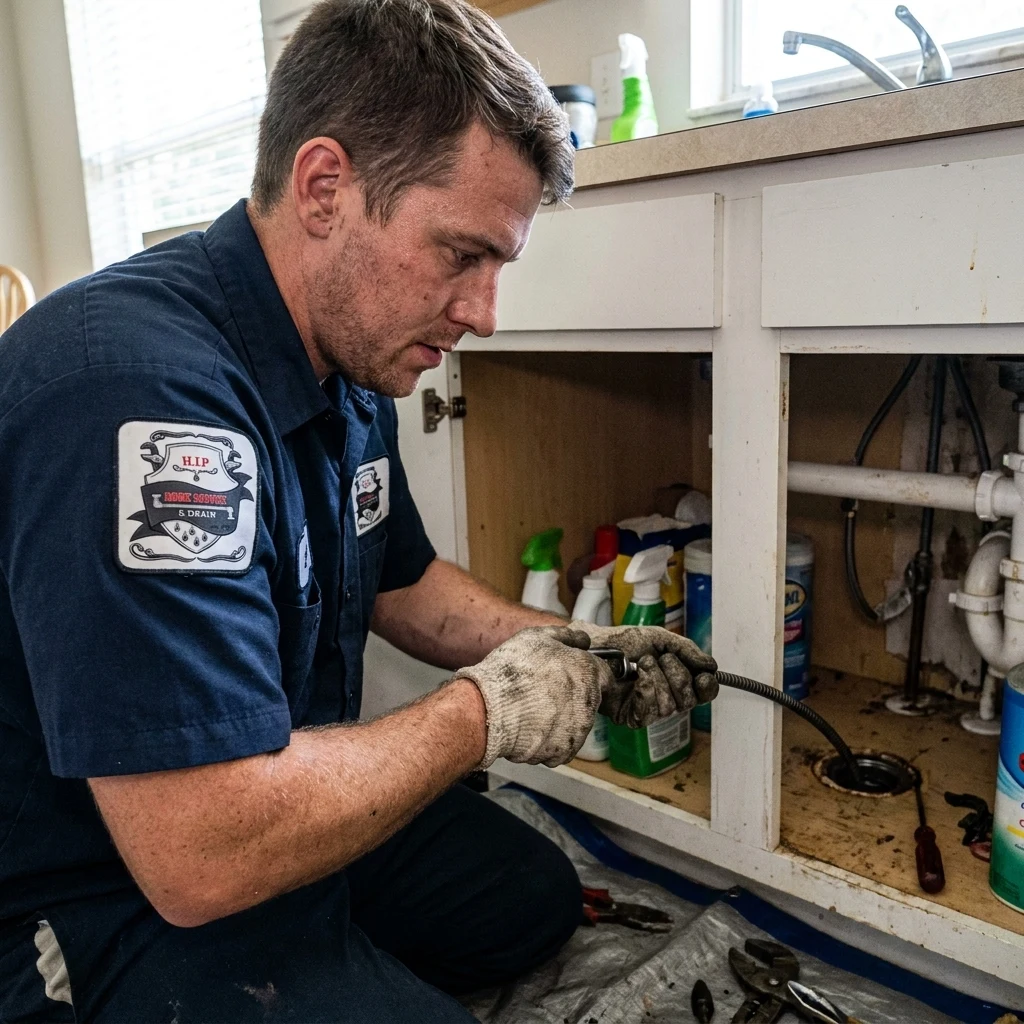
If the sink drains slowly even after the trap is clear, if it gurgles when the dishwasher runs, or if you smell sour grease at the sink, the film is probably already there. A cable can open a channel, but the coating remains. Kitchen line grease jetting scours the sink line and the stack behind it back to the wall, at $275 to $450. A kitchen drain snake is $150 to $275 and fits a first-time stoppage with a clear cause. For the choice between them, see the jetting versus snaking comparison.
If the stoppage is further along, in a branch line or the main, a camera look is the sensible next step. Our drain cleaning and snaking page covers single-fixture work. Neighborhoods built in the 2000s, such as Carillon Lakes, tend to have plastic lines where the problem is grease and wipes rather than age, while a 1920s house downtown may add scale and roots to the mix. The Lakeland service area page has more on how those differ.
Jetting does not make a line permanently immune. If grease keeps going down the sink, the film returns. What it does is give you a clean pipe to protect, and the habits above are how you protect it.
Kitchen sink slow again?
We clean the full kitchen line, not just the clog, and you get a written price before the hose comes out.
CALL 813-733-7188Kitchen Grease Questions
No. The city's policy requires interceptors for nonresidential users only. Homes have none, so grease poured down a household drain goes into the sewer, which is why the city asks residents to bin cooled grease and wipe pans.
C.O.R.E. stands for Cooking Oil Recycling Effort, a City of Lakeland program for used cooking oil. Check with the city about how to take part and where oil can be dropped off, since we do not collect it.
Not really. They push grease further down the pipe, where it cools and sticks again. Scraping pans into the trash, wiping them with a paper towel and using a sink strainer prevent far more buildup than rinsing ever will.
There is no fixed interval. It depends on how much grease goes down the drain and on the pipe. A sink that clogs more than once is the best sign that the line needs scouring instead of another cable pass.